
WHY OUR MUSICAL HERITAGE MATTERS
 Why Our Musical Heritage Matters
by Mark Evans
As our nation celebrates its 250th birthday, from the rocky coasts of Maine to the sunny beaches of Hawaii, the words of Walt Whitman ring true: “I Hear America Singing.” But what on this auspicious occasion are we singing? While we justly celebrate our Founding Fathers and the documents they wrote and ideas they promulgated that gave us a magnificent country, we shouldn’t forget the people I call our “Musical Founding Fathers,” the composers, musical artists, and teachers, who gave us our musical heritage.
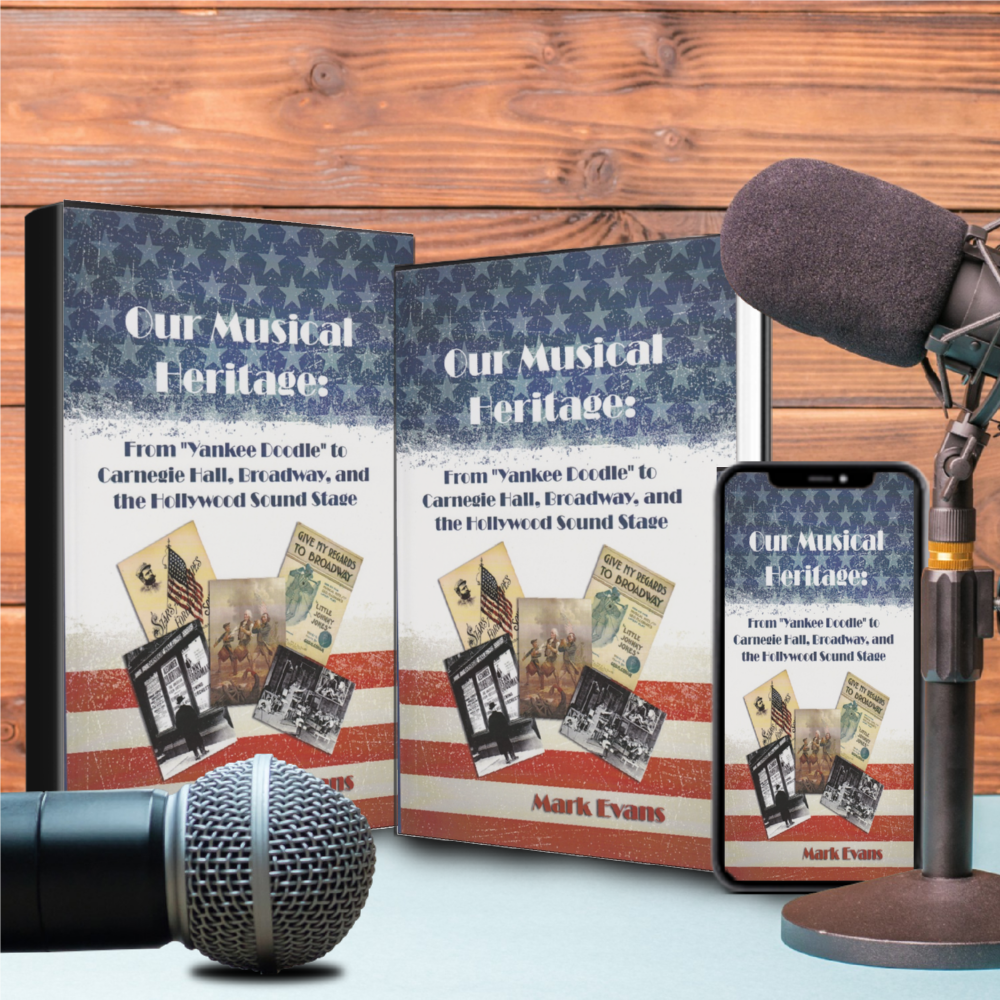
This is a subject near and dear to my heart as I’m the author of a book called, “Our Musical Heritage: from ‘Yankee Doodle’ to Carnegie Hall, Broadway, and the Hollywood Sound Stage.” It tells the story of four important genres of American music: concert music, jazz, musical theater, and film scores.
This is a subject that is rarely taught in schools. Several generations of Americans have grown up with little or no knowledge of our musical past. They are familiar only with whatever they encounter through social media, usually rock, rap, and pop.
My own serious interest in the subject came about quite by accident. As a young pianist and composer, I had studied the lives of the usual figures of classical music and read quite a lot about major jazz musicians. I had met many of the finest film composers while attending recording sessions at a major Hollywood studio. But I hadn’t really studied American musical history formally as the prestigious conservatory and colleges I had attended didn’t teach it. While in graduate school, finishing up my Ph.D., I was informed that I needed one more graduate seminar and none was being offered that year. The university proposed an intriguing solution. I would be assigned to work with an Oxford-style tutor and be enrolled in a special class. Since I would be the only student in the class, I would receive a lot of personal attention from the person teaching it. To accomplish this goal, they brought a professor out of retirement. Kenneth G. Fiske had taught for decades. He was a conductor, violinist, and dedicated collector of rare musical instruments. Despite his lively schedule, he had been forced to retire
ostensibly because of age. He had been replaced by someone younger that was, like the school’s president and department chairman, a Harvard man. (Mr. Fiske was an alumnus of the Chicago Musical College.) Happy about his campus return, he set his sights on his new class of one with enthusiasm. The subject, he told me, would be one of his specialties, Music in American History.
I soon learned that America’s musical history was populated by a vast array of interesting and accomplished people, innovators, experimenters, teachers, rugged individualists, heroes, scoundrels, and an abundance of colorful characters. One, Francis Hopkinson, was a composer who wrote songs that were said to bring tears to the eyes of his friend Thomas Jefferson and were dedicated to his other good friend, George Washington. Hopkinson wasn’t a particularly important composer; he is more remembered for other achievements, including his signing the Declaration of Independence.
Responses to “Our Musical Heritage” have been enthusiastic. However, amidst the trumpets and applause, there are always one or two people sounding a sour note. To these, I feel compelled to respond. Why, you may ask, should anyone care except the author or publisher of a book? It’s not as if an occasional criticism of a widely acclaimed book were related to something important such as war, peace, Taylor Swift’s marital status, or the latest tweet from the Kardashians.
The answer to this searing inquiry is that the comments of the occasional critic and even of those offering compliments often tells us more about those offering comments than the book itself. What is more important is that these observations offer a profound into what is a truly serious problem, the potential loss of our nation’s musical legacy altogether.
First, a word about critics. Musicians and writers are usually and understandably unenthusiastic about critics, professional or amateur. But are critics what they profess to be, impartial umpires and unbiased judges? Or do they have their own agendas? Stephen Sondheim once told me that critics were “the enemy.” The whimsical P.G. Wodehouse, perhaps with Count Dracula on his mind, asked, “Has anyone ever seen a critic in the daytime?” Acerbic British conductor Sir Thomas Beecham called them drooling, driveling, depressing, dropsical drips.”
How should one deal with critics? Paul Hume, music critic of the Washington Post once received a letter from the irate father of a singer whom he had described as singing flat and having a small voice. The letter promised him two black eyes and the need for a new nose should the two men ever meet. Hume couldn’t ignore the letter. It was signed, “Harry S. Truman, President of the United States.” Humor is often better than anger as a response to critics. One of my distinguished teachers, Roy Harris, found himself on a panel with fellow composers Aaron Copland and William Schuman, joined by frequent Harris critic, the powerful Olin Downes. In response to a question by Schuman, Downes admitted that he was unfamiliar with certain musical terms. When asked by Schuman how he criticized new music he didn’t understand, Downes sniffed, “You don’t have to be a chicken to know if an egg is good.” “Olin,” said Dr. Harris, “You’re no chicken, but you’ve certainly laid a lot of eggs.”
My friend and colleague, Charles Holbrook, wrote an article for the online publication American Thinker. It stressed the need for us to remember those who gave us patriotic music, great concert works, jazz improvisation, memorable musicals, and classic film scores. With my blessings, he drew upon stories and anecdotes from my book. While comments were uniformly positive, one in particular drew my attention.
A reader calling himself “gafferguy” asked rather impertinently, “Hey, Chuck, have a listen to Alan Hovhaness, who belongs on your list. Over 70 symphonies, which puts him right up their with Haydn.” (Charlie to his friends, not Chuck, and Mr. Holbrook to you, “gafferguy,”) didn’t mention Hovhaness and a number of others I describe in “Our Musical Heritage” as eclectic, for a reason. American Thinker is a fine platform, but like all online and print publications, it has space limitations.. Hovhaness was certainly an intriguing figure who received encouragement from no less than Jan Sibelius and pursued numerous musical interests including the music of Armenia, Egypt, and Japan. The list of interesting and important composers who created a legacy of American concert music is long. Here are just a few more of the eclectics in our musical melting pot. Leroy Anderson was famous for his light music, but also a linguist fluent in eight languages. Robert Russell Bennett was a fine composer, but his own music was overshadowed by his reputation as the greatest orchestrator of Broadway musicals. A pair of African American geniuses, Calvin Jackson and Donald Shirley, were best-known as virtuoso pianists, but were also accomplished composers. Donald Shirley was discovered by the general public after aspects of his life were explored in the film Green Book, released after his death. Calvin Jackson remains relatively undiscovered by the public, although his fan club, past and present, reads like a musical “Who’s Who.” Astor Piazzolla was an Argentine who spent his childhood in New York and revolutionized the tango. The remarkable David Amram remains a prolific composer of concert music inspired by everything from the writings of Thomas Jefferson to a Navajo prayer. He has scaled the heights on Broadway, in the realm of jazz, and in thirty-five countries he has visited, collecting and performing on instruments associated with world music. After more than seven decades, he still signs his letters to friends, “David Amram, promising young composer.” Ask the typical student and even music students or teachers who these people are. The answer might surprise you.
On occasion, readers and even those who haven’t read “Our Musical Heritage” will profess enthusiasm for American music, but than suggest that we should recognize the dubious contributions of exactly the wrong people. One print reviewer complimented me for 2/3 of a review, but then added that I had unfortunately neglected “Lin-Manuel Miranda’s masterpiece, Hamilton.” The reviewer doesn’t realize that Hamilton, a rap musical allegedly portraying historical figures, is typical of today’s Broadway’s “Three R’s,” rock, rap, and revivals. Young audiences today think musical theater began with rock operas such as Jesus Christ, Superstar and end with Hamilton. Most are ignorant of the great classics from Show Boat to Porgy and Bess, from Oklahoma! to Carousel to The Most Happy Fella to My Fair Lady.
Similarly, a radio review sang my musical and literary praises, but then added, “Of course, we can’t forget about the great rockers.” Again, she completely missed the point. Beginning in the late 1950s, but coming to fruition in the 1960s and ’70s, the rock music revolution began dominating all commercial music. Jazz musicians fled to Europe or Japan to find work. Broadway shows were expect to adapt to rock. Film composers were told to write rock or get out of the business. The so-called “great rockers” today are hardly neglected and “great” isn’t the adjective I would choose to describe them. It’s the legacy of the truly great musicians they replaced that is in danger of fading into oblivion.
Most musicians, for reasons of professional survival, chose to go along to bet along. Voices in the wilderness were far and few in between. A few jazz musicians protested. Buddy Rich, the legendary jazz drummer with lightning-fast hands spoke of the disappointing simplicity of the four-chord wonders in pop music. Jazz pianist Bill Evans (no relation) said, “Ask any rock musician to play jazz and he can’t do it. Ask any jazz musician to play rock and he can do it in ten minutes.” Bandleader Stan Kenton, after a lifetime in search of “new sounds” compared the lyricists of The Great American Songbook to those of the current hits and asked, “Who are you kidding?” Serious composers such as the eminent Miklós Rózsa spoke with integrity. The curmudgeonly Alec Wilder denounced the disturbing musical revolution.
But it was to no avail.
Ask a typical high school student, “Who was John Philip Sousa?” You are likely to get a blank stare. The march king who wrote our national march, “The Stars and Stripes Forever” was a fascinating musical figure whose life overlapped the 19th and 20th centuries. (He was an early skeptic of recorded music because the sound quality in the early days was so poor.) Efforts to arrange a meeting with recording pioneer Thomas Edison were unsuccessful. Edison was hard-of-hearing and the two didn’t get on well. Sousa wrote that “Canned music is as incongruous by a campfire as canned salmon is by a trout stream.”
Students are likely to dismiss learning about American music before their time as unimportant and “written by a bunch of old guys.” The age, gender, race, or ethnicity of composers today matter more than the quality of their musical output. The arrogance of youth has always dismissed the wisdom of the past, but today the phenomenon has turned into an epidemic of appalling ignorance. Even people who should know about our musical heritage do not. This includes a surprising number of teachers, eager to pass onto their students the standards they do not have and the history they do not know.
Hugo Friedhofer was one of the most respected film composers. Though he eschewed publicity, he was quite a colorful character, a brilliant and highly quotable curmudgeon. After his passing, his close friend Gene Lees called the Arts & Entertainment editor of the New York Times offering stories and anecdotes about the composer who won an Oscar for scoring The Best Years of Our Lives. “Hugo Friedhofer?” said the puzzled New York editor. “Who’s he?”
I was once invited to a gathering of meeting planners, with exhibitors trying to persuade the attendees to choose their venues for national conventions. The popular choices were always places such as Hawaii, New Orleans, and Las Vegas. It was always amusing to see the poor representative from Buffalo being asked, “Our meeting will be next January, what’s the weather like in Buffalo?” When I happened to meet representatives from Rochester, New York, I told them I’d never been to Rochester but that I was a great admirer of Howard Hanson. The Rochester representatives said, “Who’s he?” Dr. Hanson, the venerable Director of the Eastman School of Music, for over forty years, was a composer and conductor, the greatest advocate for American composers in the country for decades. Those promoting his own city had never heard of him.
There are thousands, perhaps millions of stories like this. The celebrity culture marches on while the true heroes of American music and their contributions fade quietly into oblivion.
On Greg Gutfeld’s popular television program, Gutfeld and his guests got into a discussion about American culture. Panelist Brianna Lyman declared that there is real culture in America. Host Greg Gutfeld, with a gleam in his eye, laughed triumphantly and declared, “If you don’t think America has culture, I’ve got two words for you, Kid and Rock.” Comedian Michael Loftus jumped in, announcing, “I’ve got two more, Lynyrd and Skynyrd.” Comedian Tom Shillue chimed in. It occurs constantly today; even advocates for American culture and American music are oblivious to what has happened. “American culture,” even to its advocates, means rock, rap, pop, and whatever is being sold at the moment online.
Contrary to what many think, this discussion should be apolitical and understanding the importance of not losing America’s musical legacy has nothing to do with politics or ideology. It is true that Americans who declare themselves proud of their country are more often likely to identify as “conservative.” But ask them about music and they immediately start talking about their favorite bands (i.e. rock groups.) Many, if not most, have grown up with the pop culture. They may consider themselves patriotic and proudly American, but when it comes to music, they know little. In contrast, there are those who consider themselves liberals who may be older or may have grown up with good music, who have a greater understanding of the problem.. It should be easy to unify across the political divide, as is said in Washington, D.C., to “reach across the aisle” in support of our musical heritage. Surprisingly, the problem can be found on both sides of the aisle. It depends entirely upon the individual
Whenever I meet someone who appreciates great music, be it concert works, jazz, musical theater, or film scores, I always ask, “How did you get interested in this music?” The answer is always the same. “My father, mother, grandparents, aunt, uncle, or perhaps a teacher introduced me to it.” Just as children will not discover our great historical figures or our exceptional history and form of government on their own, they won’t discover great music on their own either. They will be inundated by the icons of the pop culture: untalented, unproductive, unaccomplished, but heavily promoted by unscrupulous geniuses of hyperbole.
Every parent and grandparent has the opportunity to introduce family members to the best of our music. But sadly, there are those who march in the opposite direction. Instead of leading the parade down a different path, they jump behind the parade toward mediocrity and conformity.
No one personifies this pattern of behavior more than a retired Washington, D.C. attorney named Larry Gondelman. A worshiping fan of the rockers in his day, he went on to teach a course called “Songs of Sex, Drugs, and Rock and Roll.” With a title like that, it was a popular class. Gondelman proudly declares that “Having your son or daughter as your rock ‘n’ roll buddy is a wondrous thing.” Gondelman is delighted that rock music “spoke to his son’s soul” and gladly took his daughter to concerts featuring her favorites, Taylor Swift and Nikki Minaj, though they aren’t his. He looks forward to the day when he will have grandchildren and will ready to “rock on with them.”
The last thing your children or grandchildren will need is a “rock and roll buddy, likely well-intended, but incredibly misguided. To those who truly care about our musical heritage on our country’s 250th birthday, I offer the following quotation from my book, “Our Musical Heritage.” To those who object that these words are self-serving, I defer to the well-known music critic, Corno di Bassetto. (He also wrote a few plays under the name George Bernard Shaw.) Said Shaw, “I often quote myself. It adds spice to my conversation.”
The child today who discovers a beautiful string quartet, hears a beautiful jazz solo, attends a brilliant musical theater performance, or learns the difference between good and bad film music, may be taking the first step in a life that may help preserve, protect, and defend our musical heritage and move it forward. So if you are a parent or grandparent, I urge you to introduce your children or grandchildren to our musical heritage. They may not discover it on their own. It will be their loss, but also ours
Happy Birthday, America 250.
Is our musical best yet to come? The choice is yours.


